
Short answer
Air-cooled ice machines are cheaper to install and use far less water, but they push heat into the room and lose output when the room is hot. Water-cooled machines keep output stable in hot, poorly ventilated rooms but use extra water, and some cities restrict once-through water cooling. Remote air-cooled condensers move the heat outdoors.
What the condenser does
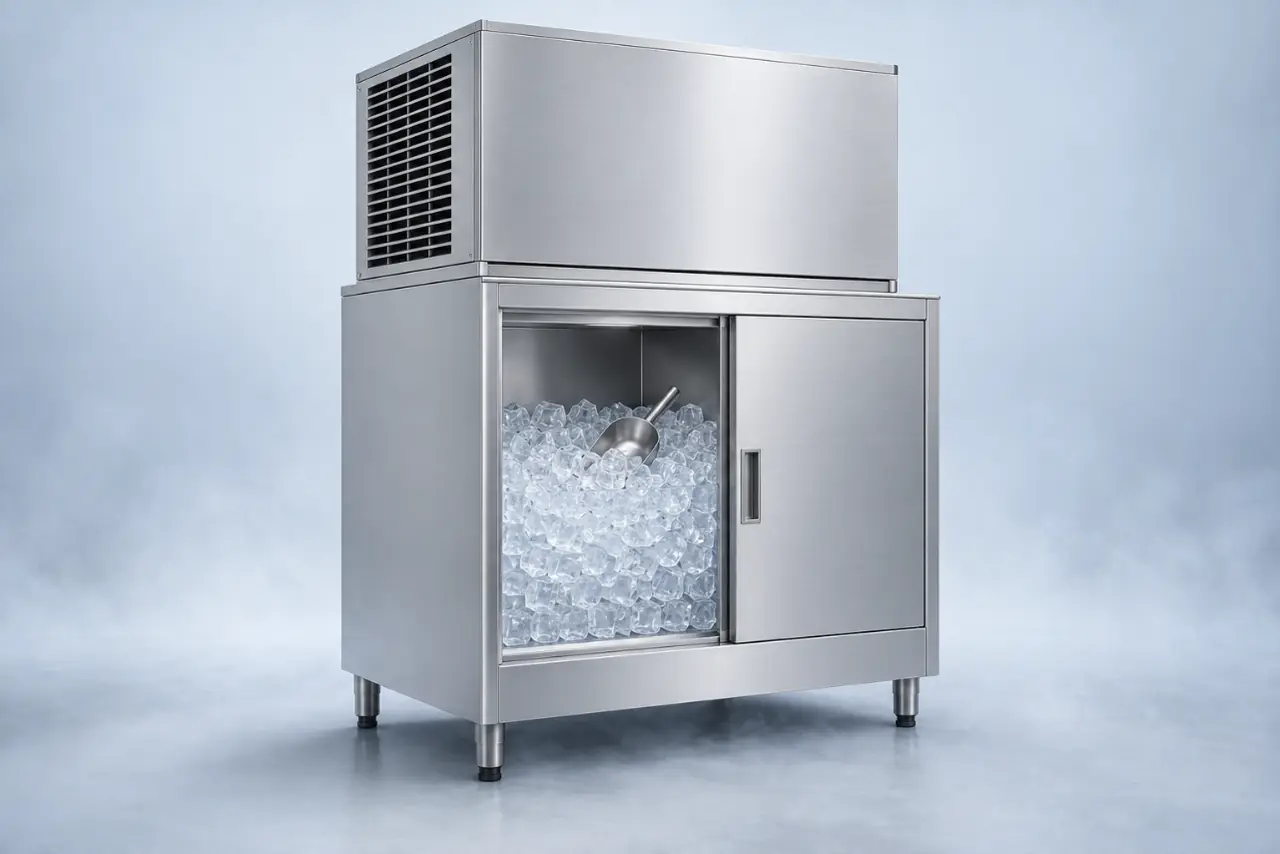
Every ice machine must reject the heat it removes from the water, plus the compressor's own heat. The condenser does that job. An air-cooled condenser uses a fan to blow room air across the coil; a water-cooled condenser passes water through a heat exchanger; a remote condenser puts an air-cooled coil outdoors.
Side-by-side comparison
| Air-cooled | Water-cooled | Remote air-cooled | |
|---|---|---|---|
| Installation cost | Lowest | Low to medium (water + drain) | Highest (line set, roof work) |
| Water use | Only for ice | Ice water plus condenser water | Only for ice |
| Heat into the room | Yes | Very little | Very little |
| Output in a hot room | Falls noticeably | Stable | Stable (depends on outdoor air) |
| Noise in the room | Fan noise | Quiet | Quiet |
| Best for | Ventilated rooms up to about 30 °C | Hot, cramped rooms where water is cheap | Large machines, kitchens already too hot |
How heat affects output
Ice machine output is usually published at moderate conditions, about 21 °C (70 °F) air and 10 °C (50 °F) water. In a 32 °C (90 °F) room with 21 °C (70 °F) water, air-cooled machines commonly lose 20–30% of their rated output. If your ice room is hot, either choose a larger air-cooled machine, improve ventilation, or move to water-cooled or remote condensing.
The water question
Once-through water-cooled machines send condenser water straight to the drain, and that water volume can be many times the weight of ice produced. Some cities and utilities limit or ban once-through cooling, so check local rules. Water-cooled machines connected to a closed-loop chiller or cooling tower avoid most of that waste.
Decision guide
- Is the room ventilated and below about 30 °C most of the year? Choose air-cooled.
- Is the room hot and small, with cheap water and no local restrictions? Consider water-cooled.
- Is the machine large (roughly 450 kg / 1,000 lb per day and up) or the kitchen already overheated? Choose a remote condenser.
Further reading
- Under Counter Ice Maker Guide: Sizes, Drains, Clearances and Output
- Nugget Ice Maker Guide: How Pebble Ice Is Made and Which Machine to Buy
- Countertop Ice Maker vs Commercial Ice Machine: Output and When to Upgrade
- Ice Ball Maker and Clear Ice Machines: A Guide for Cocktail Bars
- Ice Vending Machine Business: Machines, Output and Startup Costs
- Commercial Water and Ice Dispenser Guide: Types, Hygiene and Sizing