
Short answer
The main commercial ice types are full and half cube (hard, slow-melting, for drinks), crescent and bullet (fast-cooling, dispenser-friendly), nugget or pebble (soft, chewable), flake (dry flakes for food display and processing), snow ice (frozen flavoured milk for desserts) and sphere/ball ice for premium cocktails.
The main ice types at a glance
| Ice type | How it is made | Feel | Best for |
|---|---|---|---|
| Full cube | Water runs over a grid evaporator plate | Hard, clear, slow melting | Bars, restaurants, hotels |
| Half cube | Same, with half-size cells | Hard, packs tightly | Soft drinks, dispensers |
| Crescent | Freezes on cooled cups, released by warm gas | Hard, curved | Beverage dispensers, cups |
| Bullet | Freezes around chilled fingers dipped in water | Hollow, quick to cool | Fast food, convenience stores |
| Nugget / pebble | Auger scrapes flakes and compresses them | Soft, chewable | Healthcare, smoothies, fast food |
| Flake | Thin layer frozen on a drum and scraped off | Dry, soft flakes | Fish and meat display, processing |
| Snow ice | Flavoured milk or juice frozen on a drum and shaved | Fluffy ribbons | Bingsu and dessert cafés |
| Sphere / large cube | Moulds or cut from clear block ice | Very slow melting | Cocktail and whisky bars |
Cube ice machines
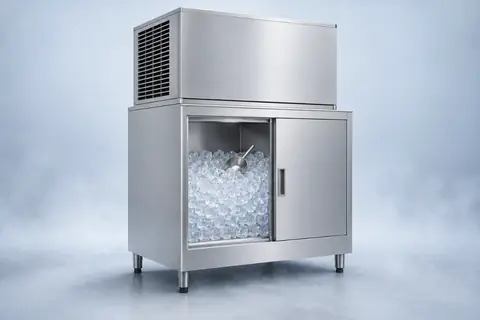
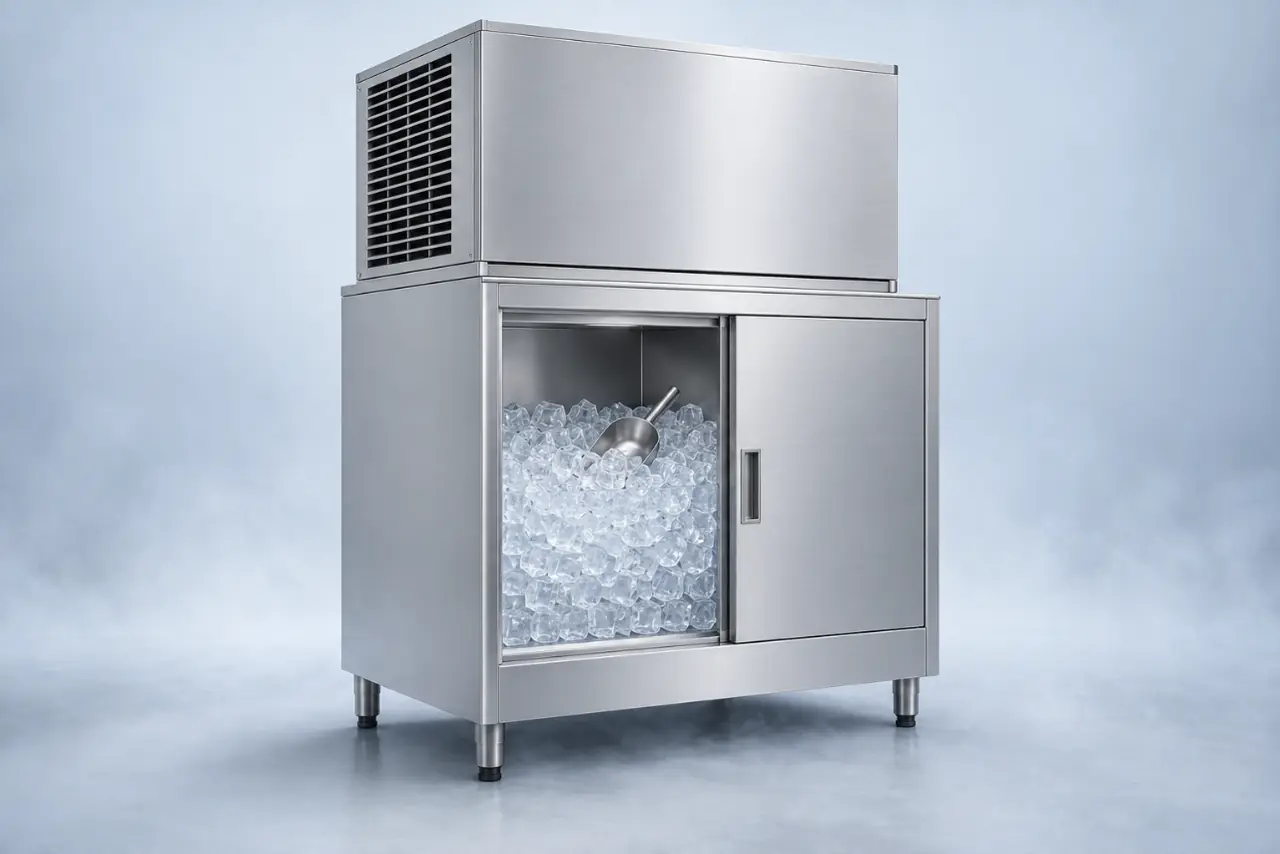
Cube machines run water over a cold evaporator grid. Minerals stay in the circulating water instead of freezing into the cube, so the ice is clear and hard. At the end of the cycle hot gas warms the plate and the slab of cubes drops into the bin. Full cubes (around 22 × 22 mm or 29 × 29 mm) melt slowly; half cubes pack more tightly into glasses.
Nugget (pebble) ice machines
An auger inside a refrigerated cylinder scrapes off ice as it forms and pushes it through a die, compressing the flakes into soft pellets. Production is continuous rather than in batches. Nugget ice is easy to chew, absorbs flavour and is often preferred in hospitals and fast food.
Flake ice machines
Water is sprayed onto the inside or outside of a cold drum, freezes into a thin sheet and is scraped off as flakes about 1.5–2.2 mm thick and below 0 °C. Because flakes are dry and flat, they mould around product and cool it fast. Flake ice is the standard for fish markets, supermarket seafood counters, meat processing and concrete cooling.
Snow ice (bingsu) machines
Instead of water, a snow ice machine freezes milk, juice or tea on a drum and shaves it into fine ribbons. The flavour is inside the ice, giving the creamy texture of Korean bingsu and Taiwanese snow ice.
How to choose
- Drinks and cocktails: full or half cube; add a sphere mould or clear block for premium spirits.
- Self-service and dispensers: half cube, crescent or nugget.
- Healthcare: nugget ice.
- Food display and processing: flake ice.
- Desserts: snow ice machine for bingsu; shaved ice machine for syrup-topped shaved ice.
Then size the machine for your daily demand with our ice machine calculator.
Further reading
- Under Counter Ice Maker Guide: Sizes, Drains, Clearances and Output
- Nugget Ice Maker Guide: How Pebble Ice Is Made and Which Machine to Buy
- Countertop Ice Maker vs Commercial Ice Machine: Output and When to Upgrade
- Ice Ball Maker and Clear Ice Machines: A Guide for Cocktail Bars
- Ice Vending Machine Business: Machines, Output and Startup Costs
- Commercial Water and Ice Dispenser Guide: Types, Hygiene and Sizing